
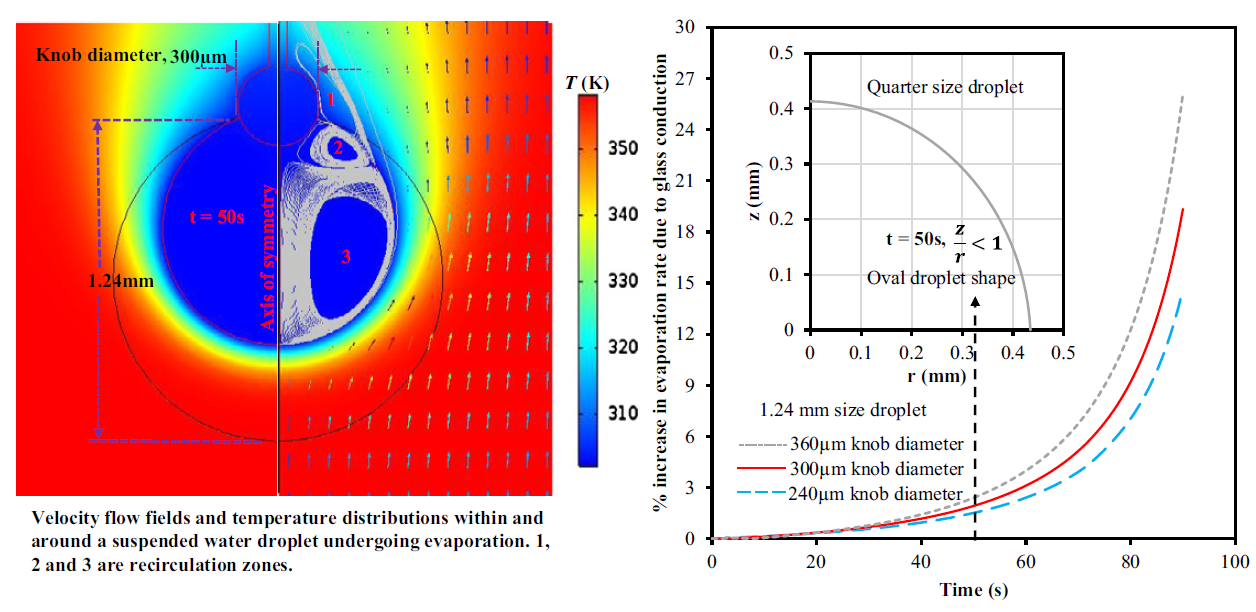
Detailed numerical analysis of evaporation of a micrometer water droplet suspended on a glass filament
George O.A., Xiao J.*, Rodrigo C.S., Mercade-Prieto R., Sempere J., Chen X.D.*
Chem. Eng. Sci. 2017; 165:33-47
Molecular-level understanding of protein adsorption on uncharged solid surfaces has been a challenge due to experimental limitations. Recent computational efforts have demonstrated that the adsorption process starts from a biased diffusion phase, where the peptide or protein tends to move towards the solid surface from a position beyond the interaction range that the surface can reach. The strong interactions between the solid surface and the water molecules adjacent or near it would establish well-oriented water molecular ‘layers’, which are said to bring the ‘net’ electro-static interactions hence exhibiting longer distance attractions. In this work, the peptide adsorption process has been investigated by resorting to a unique mesoscale modeling approach. Here, quantitative analyses on the adsorption of an A3 peptide on uncharged solid surfaces that strongly interact with water have revealed that, different from previous reports, the biased diffusion could be mainly attributed to the Lennard-Jones (LJ) forces, whose ‘net’ value could reach one order of magnitude bigger than the ‘net’ electrostatic force originated from the aggregated water ‘layers’ close to the surface. In addition to offering the new understanding of the adsorption mechanisms, promising applications of the current method for large systems beyond a single peptide are also discussed.
链接: http://www.sciencedirect.com/science/article/pii/S000925091730146X